NIGHT 12 – THE STORY OF THE SECOND DERVISH

0012_the_story_of_the_second_dervish

MEANWHILE IN ARABIA…

(Part II)

Night 250

Morning now dawned and Shahrazad broke off from what she had been allowed to say. Then, when it was the two hundred and fiftieth night, SHE CONTINUED:

I have heard, O fortunate king, that Shams al-Din told his wife: ‘It is you who are the cause of my sorrow.’ ‘Why is that?’ she asked.  ‘When I opened my shop today,’ he answered, ‘I saw that every single merchant had one, two or more sons sitting like their fathers in their shops and I said to myself: “Death, which took your father, will not fail to visit you.”  The night on which I first lay with you I swore that I would not marry another wife, that I would not take a concubine, be she Abyssinian, Rumi or a slave girl of some other race; and that I would not spend a single night away from you.  The fact is, however, that you are barren, and marriage to you is like chiselling rock.’ ‘As God is my witness,’ his wife replied, ‘it is you who are the cause of the difficulty and not I, as your sperm is watery.’ ‘What is the matter with men like that?’ he asked.  ‘They cannot impregnate women and produce children,’ she told him. ‘Where is there something to thicken sperm?’ he asked.  ‘I shall buy it to thicken mine.’  She told him to search among the apothecaries.

Next morning they were both sorry for having reproached each other, and Shams al-Din set out for the market, where he found an apothecary.  They exchanged greetings and Shams al-Din then asked the man whether he had anything that would thicken sperm.  ‘I did have,’ said the man, ‘but no longer.  Try my neighbour.’  So Shams al-Din went around asking everyone and being laughed at, after which he went back to his own shop and sat there sadly.  In the market there was a poor hashish addict, the syndic of the auctioneers, Muhammad Simsim by name, who used to take opium, opium paste and green hashish.  This man was in the habit of saying good morning to Shams al-Din every day, and he now came up as usual. They exchanged greetings, but Shams al-Din was irritated and Shaikh Muhammad asked him why.  Shams al-Din then told him what had happened between him and his wife.  ‘I’ve been married to her for forty years,’ he explained, ‘but she has given me neither a son nor a daughter.  I have been told that the reason she has never become pregnant is that my sperm is watery and that I should look for something to thicken it, but I haven’t been able to find anything.’  Shaikh Muhammad said ‘I have got something that will do that.  What would you say about someone who could see to it that, after forty years, you managed to impregnate your wife?’  ‘If you do that,’ said Shams al-Din, ‘I shall shower you with favours and benefits.’  ‘Give me a dinar,’ said the other, and when Shams al-Din produced two, he took them and said: ‘Give me this china bowl.’

When Shams al-Din had done that, Muhammad took the bowl off to the hashish seller, from whom he got two ounces of Rumi opium, together with a portion of Chinese cubebs, cinnamon, cloves, cardamom, ginger, white pepper and mountain lizard.  He pounded all these ingredients and boiled them up in good quality oil, after which he took three ounces of male frankincense in chunks and a cupful of cumin seeds.  After having infused these, he made all this into a paste, using Rumi honey.  He then put the paste in the bowl and went back and gave it to Shams al-Din.  ‘This,’ he said, ‘will thicken sperm.  You must take it on a spatula after a meal of mutton and domestic pigeon seasoned with hot spices.  Take the mixture on the spatula, eat your evening meal and then take a drink made with refined sugar.’

Shams al-Din took the mixture and passed it to his wife, together with the meat and the pigeons.  He told her to cook them well and to take the sperm thickener and to keep it with her until he needed it and asked for it.  She did as she was told and then placed the food in front of him.  After his meal he asked for the bowl and ate from it.  He liked it so much that he ate all the rest of it, after which he lay with his wife and she conceived that night.  When her periods had ceased for three months she knew that she was pregnant.  As her pregnancy came to its end and the labour pains began, the women raised cries of joy.  It was a difficult delivery and by way of a charm the midwife pronounced the names of Muhammad and ‘Ali over the baby, reciting the formula Allahu akbar! and the call to prayer in his ear.  Then she wrapped him up and handed him to his mother, who gave him her breast and suckled him. He drank until he had had enough and then fell asleep.  The midwife stayed there for three days and then, on the seventh day, they distributed marzipan cakes that they had made, together with sweetmeats, after which they sprinkled salt.

Shams al-Din came in and, after having congratulated his wife on her safe delivery, he asked: ‘Where is the child God has entrusted to us?’ She brought him a baby of surpassing beauty, the handiwork of God, the ever-present Ruler.  Although he was only seven days old, anyone who saw him would have taken him for a year-old child.  When his father looked at his face, he saw that it was like a radiant full moon and that he had moles on each cheek.  ‘What have you called him?’ he asked his wife.  ‘Were this a girl I would have named her,’ she replied, ‘but as he is a boy, no one should name him but you.’  At that time, people used to rely on omens in choosing their children’s names.  While Shams al-Din and his family were consulting about the name, someone there suddenly said to his friend: ‘O my master ‘Ala’ al-Din.’  Shams al-Din promptly said: ‘We shall name the child ‘Ala’ al-Din Abu’-Shamat.’

‘Ala’ al-Din was left in the charge of nurses, both wet and dry, and after drinking milk for two years he was weaned. He grew big and began to walk, and when he was seven he was put in a room beneath a trapdoor for fear of the evil eye.  He was not to leave, his father said, until his beard grew, and he was put in charge of a slave girl and a black slave.  The girl would prepare his food and the slave would carry it to him.. He was circumcised and his father produced a great feast for him, after which a faqih was brought to teach him.  This man taught him how to read and to recite the Quran, as well as instructing him in the other sciences, until he became proficient and learned.

One day it happened that the slave who brought him his food forgetfully left the trapdoor open.  ‘Ala’ al-Din climbed through it and went to his mother. A group of the leading ladies of the city were talking with her, and when the boy came in, looking like a mamluk intoxicated by his own beauty, they veiled their faces at the sight of him and said to his mother: ‘May God punish you! How can you let this mamluk, a stranger, come into us? Don’t you know that modesty is a part of the true faith?’  ‘Call on the Name of God,’ she replied.  ‘This is my son, the fruit of my heart, fathered by Shams al-Din, the syndic of the traders, and reared in all comfort and luxury.’ ‘Never in our lives did we think that you had a son,’ they exclaimed, and she explained: ‘His father was afraid lest he be hurt by the evil eye and so had him brought up in an underground chamber.’

Fertility, pregnany, childbirth, breastfeeding and parenting all in the 1001 Nights – all wrapped up in a single Night!

What can we learn from this important Night?

That the world of the Nights is one where magic, medicine and faith are one and the same; that miracles can and do happen; that sometimes help can come from the most unlikely of sources and those that are good and persistent are rewarded.  An older couple manages to conceive thanks to a concoction of everyday herbs (cubebs are a type of aphrodisiac Indonesian pepper historically used to remedy infertility and Marco Polo describes Java as a producer of these; note also that the frankincense must be male!) – with the magic-realist addition of a mountain lizard.*

The relationship between husband and wife in this tale is good-natured.  The husband listens to his wife in all matters, and the wife also concedes to her husband where necessary.  He has sworn not to marry any additional wife – in times when it was relatively common for a man to have two or three wives – so I like this guy.  They feel remorse for their argument – they are a normal couple after all – and the wife offers a solution for his watery sperm without blame, which the husband duly follows up.  The husband leaves the wife to give birth – a woman’s realm – with other women present and then sees his baby son when all is ready and the time is right for his wife to welcome him.  He offers her the chance to name their child but she graciously allows him this honour; their relationship is respectful and harmonious.

No need for a pregnancy test – three months of missed periods is enough confirmation.  Since pregnancy is a normal part of life and not an illness, they don’t even bother describing the second and third trimesters – they skip straight to the labour pains.  Labour is supposed to be painful.  She gives birth in the company of women who raise cries of joy in support.  The midwife delivers the baby and recites charms in his ear – magic and medicine combined with faith.  Childbirth is a sacred, not medical, occasion.  The baby is handed to his mother straightaway and she immediately breastfeeds him – the normal, natural sequence of events since time immemorial.  He drinks his colostrum, the first drops of liquid gold, and then promptly falls asleep as he should.  They celebrate on the seventh day, when the baby is already one week old.

Breastfeeding continues for 2 years, as is normal and as scientists are only now beginning to acknowledge.

School begins at 7 years old, as also seems normal to me. 

His father puts him in an underground chamber, which is not normal… note that this is also a story, with all its accompanying twists and turns… note also the similarities to the Aladdin we know and love in popular culture today, which may itself be a Western creation, based loosely on the Nights – tonight could be a contender for the original inspiration.  A merchant father, trapdoors, dodgy ‘uncles’ who waylay innocent boys, beautiful girls, riches galore, commoners raised to ranks of royalty, near-death experiences, love separated then reunited, talismanic jewels (a magic ring?) that can cause sofas to fly and feasts, gardens and palaces to appear from nothing…

*There are other translations of the Nights which describe slightly different recipes such as Richard Burton’s:  ‘So he gave it to him and the broker betook himself to a hashish-seller, of whom he bought two ounces of concentrated Roumi opium and equal-parts of Chinese cubebs, cinnamon, cloves, cardamoms, ginger, white pepper and mountain skink; and, pounding them all together, boiled them in sweet olive oil; after which he added three ounces of male frankincense in fragments and a cupful of coriander-seed; and, macerating the whole, made it into an electuary with Roumi bee honey’ – skink is the mountain lizard here.

Mathers 1990: ‘He took two ounces of Chinese cubebs, one ounce of fat extract of Ionian hemp, one ounce of fresh cloves, one ounce of red cinnamon from Sarandib, ten drachms of white Malabar cardamoms, five of Indian ginger, five of white pepper, five of pimento from the isles, one ounce of the berries of Indian star-anise, and half an ounce of mountain thyme. Then he mixed cunningly, after having pounded and sieved them; he added pure honey until the whole became a thick paste; then he mingled five grains of musk and an ounce of pounded fish roe with the rest. Finally he added a little concentrated rose-water and put all in the bowl.’ Both these versions are notable for their descriptions of the origins of all the ingredients, which also belies the fact that these items were traded regularly; we sometimes erroneously think of our world as the only globalised world but the fact is that in the past, their world was teeming with trade too.  Since this version includes mountain thyme, I wonder if the lizard could be a mistranslation – any Arabists who can shed light on this?

Rashid al-Din - Rashid al-Din, Djami al-Tawarikh, early 14th century.

Miniature painting of a lady breastfeeding from Rashid al-Din, Djami al-Tawarikh, early 14th century
NIGHT 11 – THE STORY OF THE FIRST DERVISH

0011_the_story_of_the_first_dervish

ON THE REST ON THE FLIGHT INTO EGYPT

(Part 1)

Picture this: it’s the middle of a long winter night. A young woman, nervous, apprehensive yet resolute, gives birth to a baby, with the support of her equally nervous yet steadfast husband. The child is not even his, yet he is totally supportive – a good man and true. They are surrounded by animals and are miles away from home. This is not by choice. They have no midwife.

They are, essentially, refugees.

The woman has just given birth for the first time. It’s a boy! By the grace of the universe her baby is healthy and full-term.

She’s exhausted. They are happy and nervous, like all new parents, with the added burden of being on the run. She takes a quick breath and snuggles her baby – and then, having barely delivered, they have to go. Again.

So, with the gritty determination that awakens at the moment of birth and unites the couple like never before, they pack up and flee while it’s still night and they are under cover of darkness.

And they ride, with only the stars and their steely resolve to guide them to a safe haven for the sake of their precious cargo.

They ride and ride and are tired. Eventually they realise that they have covered some distance and have not been followed, and it’s now safe to take a quick break. Small relief for the couple, who can finally catch their breath before continuing on their journey.

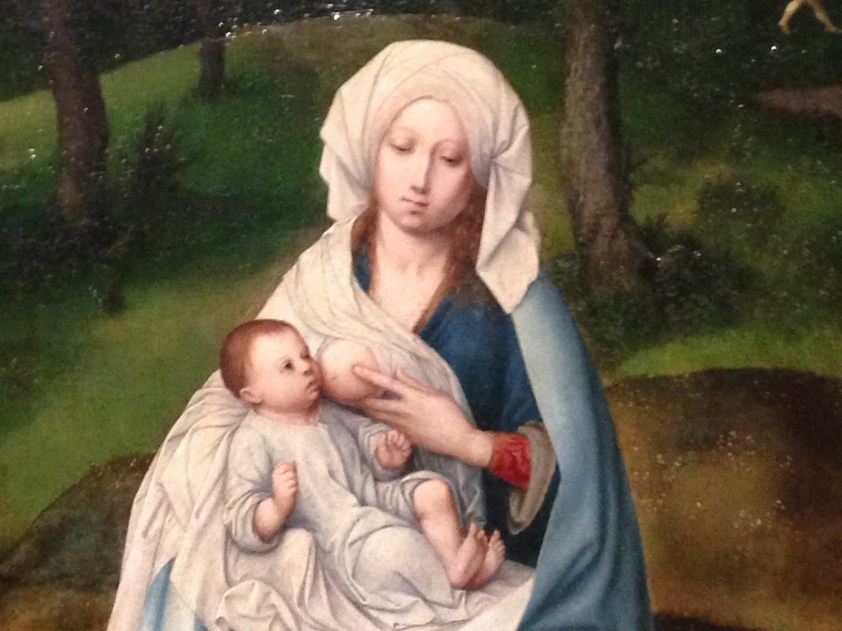
The first thing the woman does is to pause, scoop up her little boy and breastfeed him. She does this through instinct alone, with no one to guide her, although perhaps she has grown up seeing other women do it so she does have a vague idea. But this is her first time, and she has to feed her son – she has no other choice – he’s a hungry newborn. Infant formula won’t be invented for another 2,000 years.

The woman’s name is Mary. Her baby’s name is Jesus.

This pause is called ‘The Rest on the Flight into Egypt’ and it’s one of the most famous, most painted moments, indeed sacred moments, in Western art history. I understand why. It’s the first moment of real bonding of mother and child. It parallels the rise of landscape painting as a respected genre in itself (another vested interest of mine since I locate my own work here). It’s the first break the exhausted couple has – and lest we forget – they are refugees that have just given birth to a miracle.

Artists throughout history would have been surrounded by breastfeeding, if not witnessing their own families, then those of other people. (There are other genre paintings depicting more mundane scenes of everyday life which show breastfeeding.

I’m currently collecting and compiling images of breastfeeding in art and literature throughout history as I continue on my own journey with my child.  Sometimes it’s a natural part of mundane everyday life, and other times it is revered as a sacred act.  I find these references in unexpected places, when I’m not looking for them at all, and it’s a nice reminder of something that connects me to the long line of our female ancestors since time immemorial… anyone who has ever breastfed is part of this chain that links us to our original, mammalian past.


Meanwhile, in Arabia…

(Part II)

IMG_6181

From the Prado Museum, Madrid:

Patinir, Joachim (1480-1524)
Rest on The Flight into Egypt
1518 – 1520. Oil on panel, 121 x 177 cm


NIGHT 10 – THE STORY OF THE PORTER AND THE THREE LADIES


0010_the_porter_and_the_three_ladies

‘Walk a mile in another person’s shoes’

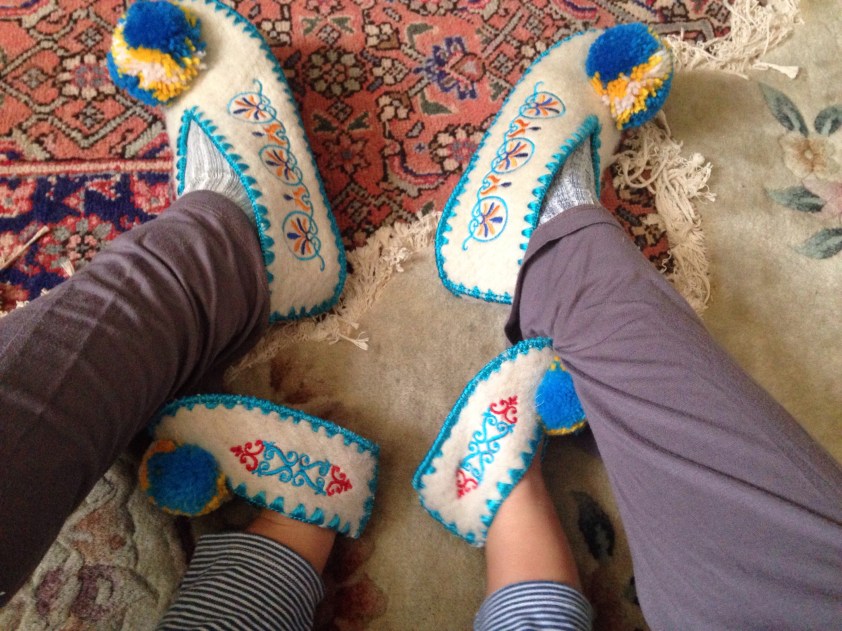
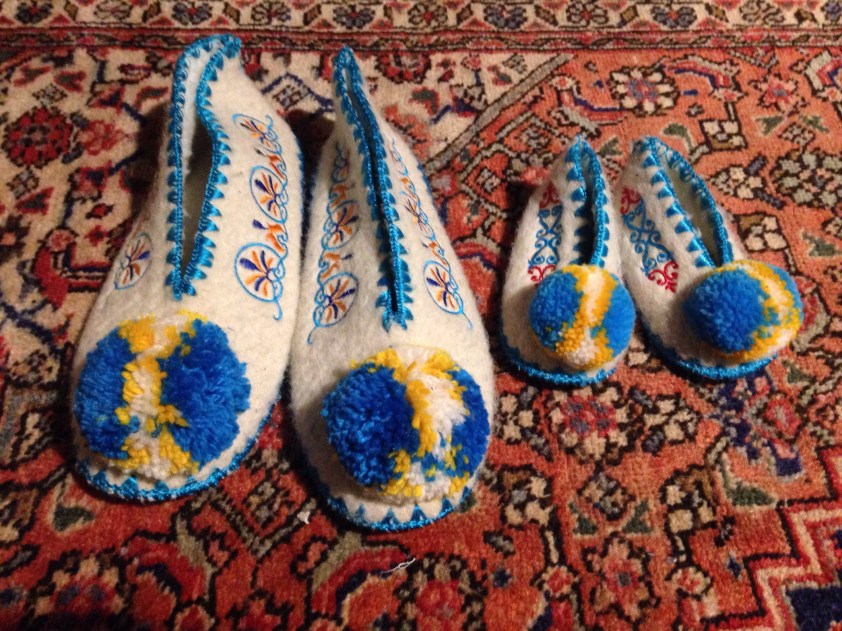
As part of my general relentless anti-racist drive I have a mini-project for my baby son to collect shoes from other cultures as far as possible for him to wear. I’m sure it’s been done before by countless parents because it’s also fun. Thus cultivating empathy, respect and love of all cultures. I look forward to more shoes (I love shoes and hats anyway – I am not into buying kiddie things really but books, shoes and hats are great exceptions)

So it starts with these Greek slippers!

NIGHT 9 – THE STORY OF THE FISHERMAN AND THE ‘IFRIT

0009_the_fisherman_and_the_ifrit

ON CARPETS AS FLOATING ISLANDS


May the road rise to meet you, and the wind always be at your back – traditional Irish blessing

I am a floor-based person. Maybe it comes from the East; maybe it comes from living alone for years; maybe some people are just built to sprawl. I love to live on the floor. I love to do everything on a clean floor – painting, working, eating, tea-drinking, playing, sitting, reading, meditating, exercising, napping, dreaming. It is when I am at my most relaxed. I can melt into the floor, wallow in it; it is one of the safest places. One cannot fall from the floor.

Beanbags help with comfort for my back when needed; I am cross-legged with a woven band around my knees to ensure my back stays upright with correct posture in my favourite photo. A meditation cushion sometimes helps ease my lotus position into classic Buddha pose for quiet reflective times. As a child, given a choice and a chair, I would gradually recede and succumb to gravity – I always ended up on the floor. Slumping and sliding until I finally folded over and curled up to concentrate on whatever I was doing. I am happiest and at my most comfortable when I’m sitting on the floor cross-legged.

Being grounded keeps you connected to the earth; yogis and monks both practise on the floor. If you feel lost, hold your ear to the ground and feel the earth’s ancient heart beating. Traditional societies lived on the floor. Architect Witold Rybczynski divides humans into those that are chair-based, and those that are floor-based. Anthropologists remind us that it’s most natural to sit on the floor, and it is seemingly unrelated to climate and culture – you find a mix of both floor and chair people across the globe. Miniature painters work on the floor. Being of either persuasion influences your whole life – how you dress (loose clothes for ease of slinking down), what shoes you wear (slippers vs lace-up boots), whether you take them off when you enter your house, the height of your shelves, the rest of your furniture (if necessary at all)… I dream of Mediterranean marble, or underfloor heating in England. I compensate with a beautiful carpet.

A carpet is like a little island – a whole world encapsulated symbolically in the pattern and physically within the borders. But carpets are not always on the ground – they are portable floors that can be rolled up and removed to wherever they are needed. They can even lift off and fly. And then they become floating islands…

I imagine that the boundaries of my carpet are the edges of my little island. There I am, firmly in the centre of my world, calm and in control with everything I need to hand. It’s all I need, my little piece of the world. My space has a shape and a frame. The 360 degree vision all around me is echoed by the pattern of the carpet, repeating outwards from the centre until it reaches its borders. Whatever doesn’t fit on my carpet, I sometimes imagine, isn’t necessary.

So my rug of choice is a flying carpet, floating serenely through the sky while I sit cross-legged, bum firmly planted in the middle. The cross-legged position, based as it is on a triangle, is a very grounded, stable position. 3 is the geometric minimum number for 3-dimensional stability like a tripod, since 2 collapses. It is a position that, if done correctly, can be upheld for hours on end with only minimal shifting; there is a reason that it is the basis for the classic meditation posture. The following structure is also triangular in form and is always true; everyone on earth shares this same basic design (siblings are a bonus):

The Russian word for family is семья – семь-я. 7 x ‘me’. Here is a basic diagram:

дедушка  – бабушка            дедушка – бабушка
отец                    –                    мать
я

Grandmother – Grandfather              Grandmother – Grandfather
Father                            –                        Mother
Me

These are your roots. Visually your roots are triangular and stable in form. Your background is distilled to a fine point, the tip of the triangle – you. The future may be behind you, as it is for the Maoris, always mindful of their forefathers. The future may also be ahead. Both are correct. Inverted, your family tree becomes a pyramid – or a mountain. At the top of the triangle-mountain, you can fly. Abraham Maslow’s hierarchy of needs is a pyramid, starting with the physiological, moving through safety, love and belonging and esteem and peaking in self-actualization – the flight of the soul.

One needs to plumb the depths of one’s roots before one can soar. To be secure. To feel the ground under your feet as a springboard from which to fly. Then the world becomes yours. Take your roots with you. Floating islands always have dangling roots – they are memories of places left behind, ready to be planted again wherever the wind takes them. Pandora’s floating islands in the film Avatar are as realistic and plausible as a moviemaker could design and the attention to detail is minute – I always watch out for the trailing roots. Roots absolutely uprooted, all the better to be immersed in new soil.

I have moved across cities, moved across continents. Moving has eroded my island – and therefore shaped my life. A rock, subject to the elements. A lump of clay, handled. They have indeed lost part of their material selves – but they are also refined. They have been formed. They are defined by what has been taken away. I sometimes get the feeling that one must be light: lightweight; spiritually light; made of light; not eating meat; not consuming too much and ready when the wind changes direction. Roll up your carpet and move on to the next pasture. Bring only your stories. Tell only your tales. I don’t believe you must lose your roots if you move. Be like a floating island, and take them with you ~

NIGHT 8 – THE STORY OF THE SEMI-PETRIFIED PRINCE

To sleep, during our Nights, perchance to dream.

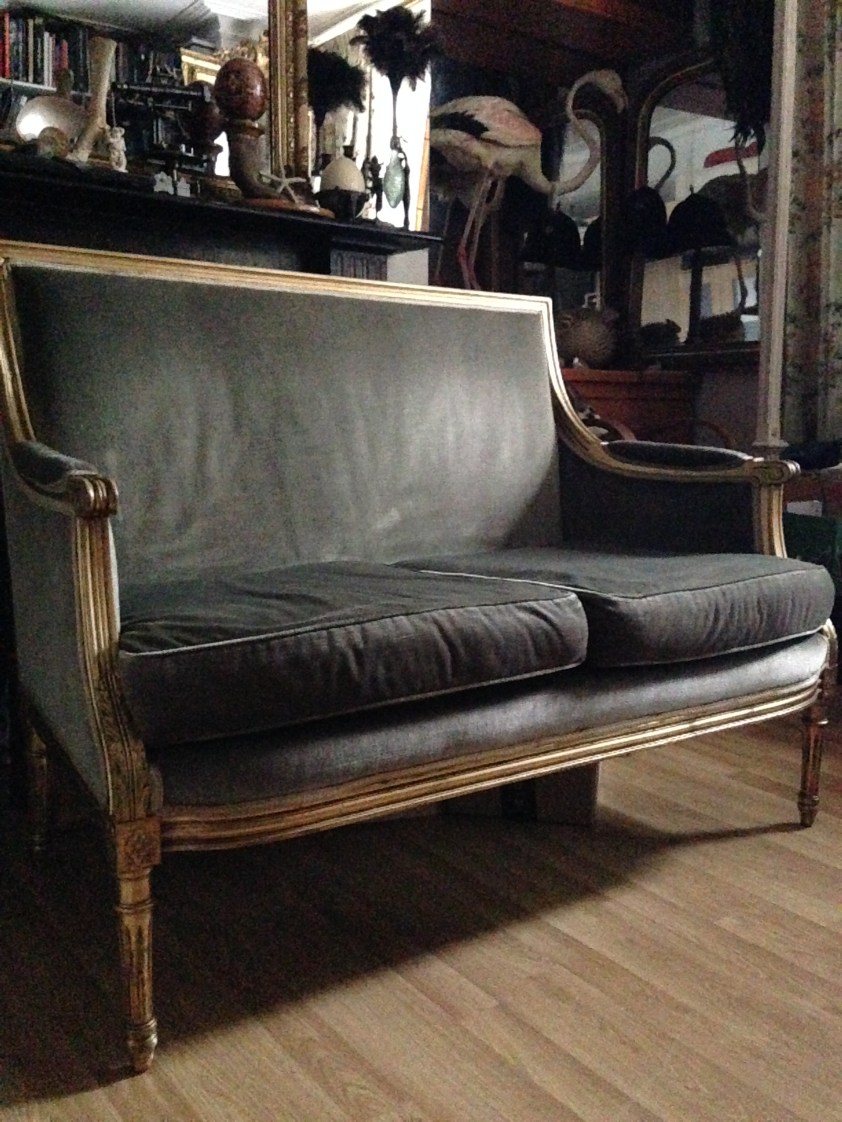
ON THE PERFECT SOFA

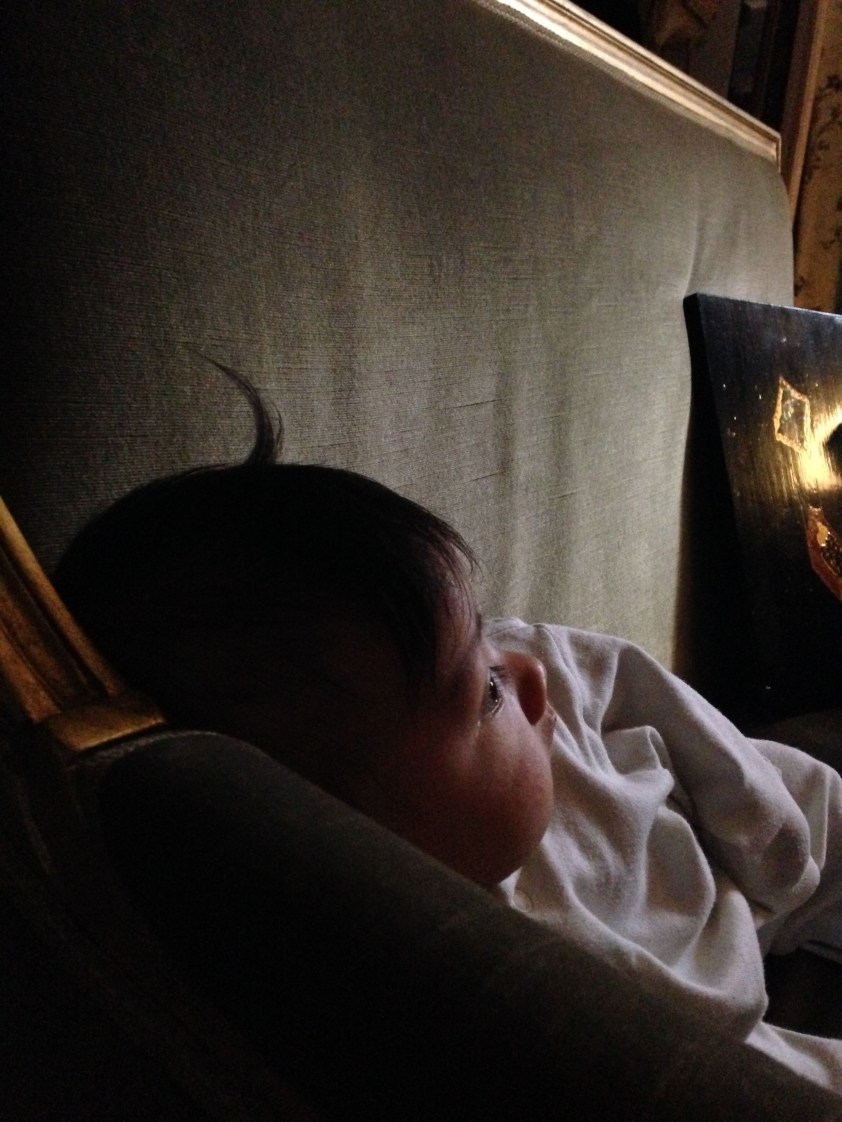
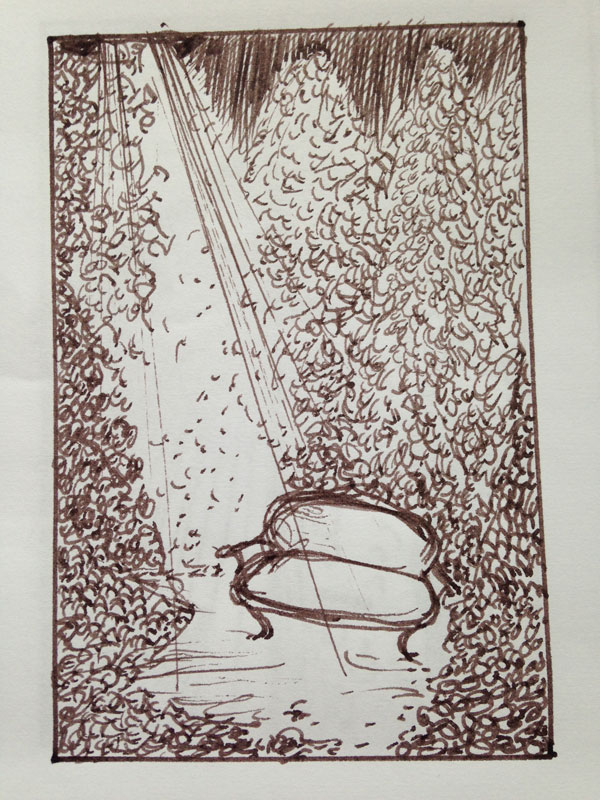
The perfect reading sofa – a calm, slightly murky greyish green you can relax into with a velvety sheen that catches the light; gold-gilt framed edges that surround you and comfortable upholstery that has no need for cushions.  Fit for two, when we read it envelops us and allows us to escape into the world of the Nights ~

perfect reading sofa 1

perfect reading sofa 3 baby

0008_the_story_of_the_semi_petrified_prince

NIGHT 7 – THE STORY OF THE SEMI-PETRIFIED PRINCE

My own unicorn dream, projected for my son at bedtime, in honour of Blade Runner 2049 ~

ON ISLAMIC ILLUMINATION – THE ARABESQUE

How can one not be entranced by these beautiful swirling patterns with no true centre? No centre but centres everywhere. The arabesque is like the map of a city. Little pockets of interest to hold your attention that quickly lead you on, via a twist and a turn, to another focus round the corner. I am mesmerised and calmed by these spiralling forms that are at once endless and finite, dancing ghosts captured by the edges that contain them.

Variously known as the Arabesque in the West, but also as biomorphic design, vegetal ornamentation, scrollwork, Islamic illumination, islimi/eslimi, tazhib/tezhip, they are a collection of forms that characterise Islamic art and were a synthesis of older cultures spanning China to North Africa. Indeed, khataei – a central component of the form – denotes those that stem from Cathay, China, and traditionally, anything Rumi meant those connected to Rum: Rome, or the Byzantine Empire. These are ancient motifs, collected the world over then transformed under the starry skies of the desert. The ancient Arabs took these things that exist in nature and made them unreal. No longer bound to the earth, they set them free, forever to whirl in their kaleidoscope ways over tiles and carpets, miniature book pages and grand towering architecture. They released these free spirits to cover the world, touching every surface, sparking true joy. (The desert peoples, observant of heavenly phenomena as they were, also folded clouds neatly into the heart of these patterns.)

Palmettes, rosettes, lilies, leaves, foliage, stems, spirals, waves, clouds, wings, dragons, phoenixes, simurghs and a calyx betwixt: these motifs include geometric, vegetal, animal, weather and even figural motifs. They uncurl like ferns, they curve and roll, they bifurcate, they split, they fork, they hit and run, they glance back on themselves, they shiver and tremble, they pulsate and vibrate, they weave in and out, they crest and peak like waves, they return and do it all again. They are round, ribbed, feathered, fluted, convoluted. In short, they are alive.

If we think about these motifs historically then we place them in a specific space and time, which is useful. Contexts are great starting points. But if we think about them symbolically, they become timeless and universal, which is far more meaningful. Poetry is not based on fact but on feeling. Thus they transcend their origins (do they ever matter?), laughingly go back to their Divine source, teasing adamant academics and frustrating scholars alike who fail to see past this simple truth. I am trapped and then released by these strange patterns that hold me in their maze then let me go. Always I see something new, find a new trajectory through, always I learn something. I am charmed. I like these bubbling, boundless patterns and could willingly lose myself in them.

They instantaneously connect me to the past, present and future, to the earliest times in which they were drawn, to the cultures that spawned them that are forgotten. Herein lies their legacy. Humble carpet weavers and mighty architects alike have all been at one time or another hypnotised by their rhythm. I always like to think of the humble Persian carpet weaver who is considered unlettered, yet who holds within her hands a vast repository of patterns that flow automatically from her fingers – she is in many ways far more literate than I am. I liken this to the oral Indian storyteller who holds entire epics in his mind, complete with rhythm and rhyme – on learning to read and write, all his memories are lost, in time, like… tears in rain. (The season of Blade Runner 2049!)

They start with a kind of centre, of course: the middle, or the bottom from which all things spring. But it is not a true centre; the eye, restless, wanders, thereby being forced to take in all of its creation. The patterns demand that you look at them as a whole. The eye travels, rests briefly on a focal point, then sets off again – at times re-entering the same focal point via a different meandering route, other times wandering off on a tangent to discover something new. There is no real end and no real beginning. They are infinitely, inexhaustibly wondrous.

Every part is equal and does not overpower its neighbours. All parts are respected and have enough personal space to breathe – yet not so much that they get lonely. There is no ego, no ‘I’. The tiniest element has a role and a meaning, without which the whole structure would collapse. Everything is necessary. There are no others. Perfect harmony, encoded. World peace, encapsulated.

Often, when confronted with something as vastly exciting and shimmering with possibilities as the arabesque, and finding it hard to categorise what it is, I look for what it isn’t. It isn’t a still, calm or stagnant lake; it’s a flowing river. It isn’t a solid mountain; it’s all the teeny tiny rocks that make up its mass.

My love for these forms grew as my little foetus grew and transformed inside me. They both started life as spirals. The arabesque emanates growth and is excited and eager to grow, move and dance around with the sheer joy of being alive now. I too have fallen under the spell of the arabesque, like countless other artists before me and doubtless countless others to come. This connectivity is reassuring, yet I feel as though I have a place; the patterns are accommodating, having already absorbed a multitude of cultures into their midst.

This is what makes one breathless with joy. Always moving, always travelling. An ancient metaphor for our modern nomadic times. One never steps in the same river twice. It’s the same with the arabesque. There is no need to trace the same route twice, because the flowing possibilities are infinite ~

0007_the_story_of_the_semi_petrified_prince

NIGHT 6 OF 1001 – THE FISHERMAN AND THE ‘IFRIT

ISLAMIC BOOKBINDING I WITH DR SHAHRIYAR PIROOZRAM

Handmaking own tools for use in leather tooling; a selection of the Master’s tools; sharpening the edges; splitting leather; interesting tool seen in the workshop (I think for ceramics!); my very own leather tool.

Splitting the goatskin leather by hand was difficult and requires practice.  I managed in the end with patience and perseverance!

It’s lovely to make one’s own tools; I shaped mine to fit snugly into the palm of my hand for ease of working.

Thank you Dr Shahriyar!

ISLAMIC BOOKBINDING II

Bookblock; bone folder; non-plasticized pH-neutral EVA glue for expediency (traditionally would have used rabbit skin glue or a plant-based root glue such as asfodel, similar to tapioca starch, which survives centuries!); cutting cardboard to size for the cover with a slight overhang; cutting leather for the cover; skiving the goatskin leather. Goatskin is the leather of choice for traditional bookbinding as it is finer than calfskin.

Skiving the leather involves taking a shallow bevel off the leather by hand using a special flat rectangular or scythe-crescent shaped tool. It’s best to handmake one’s own tools for these, to fit into one’s own hand snugly for maximum control, so that is for another time.  Skiving the leather is a difficult skill which requires practice; I couldn’t do it the first time and the second time I still couldn’t do it, although I got 1% better… implying that after 100 times I will be able to do it!

ISLAMIC BOOKBINDING III

Pasting the leather to the boards; pressing the book boards; rounding the spine using the edge of the table; gluing the book block to the open leather of the spine; tying cord round the hinge to increase the indent (this can also be done with a metal tool to create a pattern; this nylon cord and rope did an approximate job); pressing to finish.

My favourite part of making the cover was rounding the spine around the edge of a table: such a simple move and yet so effective!

ISLAMIC BOOKBINDING IV

Tezhib islimi – arabesque biomorphic design – torang shape drawn by the Master for me to copy as we wanted the spine to have a direction (pointing North); my tracing of the final design, ready to cut out; template cut out and scored onto the leather; cutting out the design from the leather and lifting it out; splitting the leather of the cutout; stiffening the floppy, fragile leather ‘veneer’ with starch paste and letting it to dry, pressing it flat in the press overnight.

Splitting – paring – the leather (perhaps this originates from the word ‘pair’ as you end up with a matching pair of leather surfaces?!) is difficult.  Perhaps as difficult as skiving (bevelling) the leather, but I can imagine with practice this skill will improve. It takes all one’s attention and is very absorbing. Any distraction and the fragile leather is liable to tear – mine tore in two places (because I got distracted…twice!). However, the Master says this is fairly normal and that the piece was good to use. As another bookbinder told me, let’s not make the craftspeople of the past into gods and idols – they were humans too, they got distracted, and if you look closely at many works of traditional art, you can see the humanity, the quirks, the hands of the people that lived long ago and loved their craft, their knowing touches all embodied within these breathtakingly complete works of beauty.

​​

ISLAMIC BOOKBINDING V

Enjoying the flattened leather ‘veneer’; having fun water gilding the leather and bookcloth corners with 12 carat white gold and the back bookcloth torang with 23 carat yellow gold; water gold size; allowing to dry and transferring the designs to the back; cutting out the intricate tezhib/tazhib islimi shapes inside the leather and bookcloth.

This is the Year of Gold for me. I love ‘gold’ gold, Renaissance gold, yellow gold, and all the varying colours that gold appears in. White gold is equally beautiful, its appearance is a warm silver colour with an added quietness and softness. This gentleness suits Islamic book covers very well I think and will complement yellow shell gold beautifully. As a contrast I also applied yellow gold leaf.

I adore the gilding process and regularly use gold gilding in my work. I have never used white gold before so this was a nice highlight of my day; because it was 12ct it was lighter and thinner to handle, and therefore a bit more flyaway. Sometimes this quality makes gilding easier; sometimes the heavier weights of gold (22ct and above, to 23, 23.5 and 24ct Renaissance gold) makes gilding easier, depending on the job, the time of day, the weather outside (gold responds to the atmosphere and the slightest breath of air causes it to float; beaten loose gold leaf is an amazing substance that seems lighter than air), other people in the studio, the energy in the air, the energy of one’s hand, one’s current mood and the phase of the moon…

ISLAMIC BOOKBINDING VI

Painting the backgrounds; here I am in my element so I felt like I knew what I was doing!; tucking the cutouts under the leather for a more seamless transitions; inserting and sticking the cutouts to finish; lining the book with gold.

Now the process got quite straightforward; it involves painting and the final touches. Painting on leather is much the same as painting on paper except for the fact that the paint is not absorbed as much, it sits on the surface rather than being absorbed in, as with paper or silk. The top right hand corner has a silk background (just to try all the different techniques). The book is taking shape slowly, and looks like an Islamic book now; the colours remind me of Central Asian colours!

With enormous thanks to my mother for looking after baby Caspian, without whom I would never have been able to do this! I love you mama~

IMG_4899

“Be fleet of foot, my little friend, and take your stories with you!”

said Vaishali to her little son one afternoon.

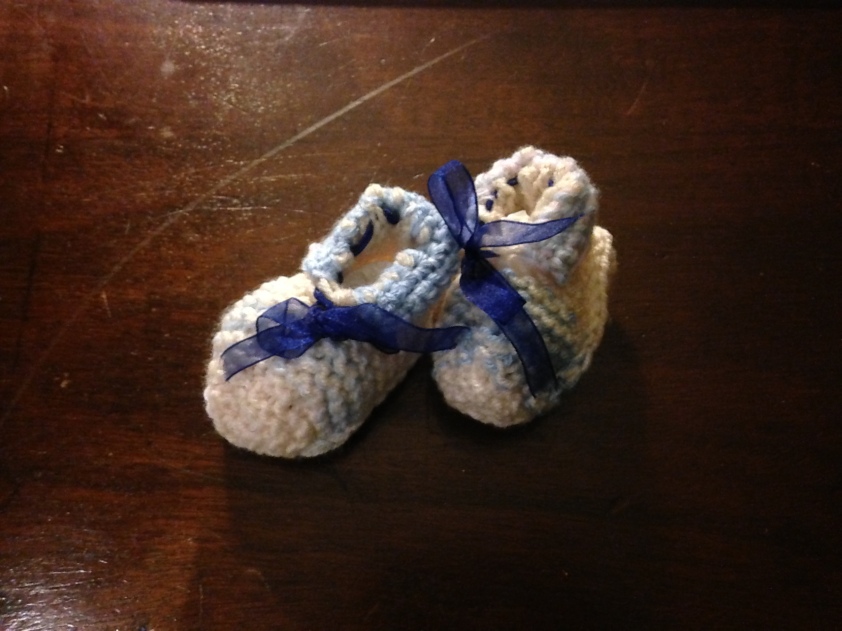
Thank you Doris for the bespoke knitted little booties ~

0006_the_fisherman_and_the_ifrit\

ON STORIES AS PORTABLE EMPIRES

I think of stories as portable empires.

Wisdom distilled and truth embellished.

Stories are extremely portable. You can take them with you. They don’t weigh much; stories are light. Material possessions are heavy. The 1001 Nights idea was conceived at a time when we received our marching order. Moving house is tough enough without childbirth in between. Using my 1001 Nights brackets analogy of stories within stories, it looked a little something like this: Forward March! Move (Give Birth) House!

Or, more precisely: Forward March! Move (Give Birth [Rest A Bit {Thanks Mama}]) House!

I found a calm oasis in these stories and they centred me, and so miraculously was given a way to be very happy during pregnancy, which I believe passed on to little Caspi. This was an extremely stressful and chaotic time for us as we commenced the move during the last trimester and finished in the early months with our newborn baby. I suppose the idea came to me as a way to order my postpartum life; paring it down to the essentials, it is a simple way to mark the progression of the Nights off a calendar and honour the passing of time.

Stories – and the lessons they offer – are more valuable than gold for the education they impart. They are a way of teaching Caspian about the world. How fortunes rise and fall; how one man’s poison is another man’s medicine; how the worst of times can be followed by the best of times; how fickle Lady Luck is; how one’s moral choices affect one’s life path; the role of fate and destiny; the straight and narrow. All this is contained within the Nights. I want to envelop us in its parallel world.

One Christmas as an art student I cooked a three-course meal for a homeless man whom I passed daily as I left my flat. He used to collect bus tickets and other tickets and pass them onto me in the days of paper tickets; some already used, some still valid (I would airily hold my hand over the time and date, nonchalantly flash them at the bus driver and it worked without fail; I breezed through every time). One of my father’s life lessons to me was to always offer food to everybody as it is one of the greatest gifts. As a poor art student I appreciated the value of food and understood how to live hand to mouth, always wondering about the next meal. I’ve been almost down and out in both Paris and London.

And we talked. I gave him a hot meal; he gave me stories. I gave sustenance yet I received more; food for thought. Stories are food for the soul. It occurred to me that stories were pretty much all he had. I learned loads – he’d travelled the world and cooked for royalty. I didn’t ask why he was homeless (does it ever matter?) and I’m not sure he wanted to talk about it. I have no way of knowing whether all his stories were true. Then again, are any stories really true? We see we want to see and we remember what we want to remember. We even refer to lies as tall stories. All I know is that he criticised my cooking in a sharp and focused, keenly precise manner worthy of a chef and offered me practical, specific advice on how to make it better next time. He carefully considered every mouthful, discerned all the ingredients with the palate of a master taster and rattled off tips on how to manage a ship-shape kitchen and serve hot food simultaneously to hundreds of guests, some of them royal. His story was the personal empire of his life. I don’t think I’ll ever need to cook for multitudes and I’ve already forgotten most of what he said. But I remember the feeling that wintry day, the closeness of kings and vagabonds, and I was astounded.

It’s always worth listening to the stories of others. They are their personal kingdoms. The 1001 Nights protagonists always make time for stories – even on the brink of death. This is an inviolable rule of the Nights. Even as a king is about to put someone to death, the victim cries: Wait! Do not do as such-and-such a person did in the past! The king, suddenly captivated, enquires: What is the tale of that so-and-so? And promptly with that, the mood entirely changes and shifts from the sense of an ending to a new, fresh beginning: ‘It so happened that X…’ Stories are too good a learning opportunity to pass up. I envisage this situation like a freeze frame: the action is about to be brought to its climactic end, all characters are holding their breath when – “Hold it! All change! Everybody freeze! – Now, did you ever hear the tale of that such-and-such a person?…”

A shift in mood, a raised eyebrow, a sideways cock of the head and a delicious Mmmmm! of interest from all parties. The executioner is told to stay his hand, the sword is suspended in mid-air and all glittering eyes turn toward the storyteller. For them, a quiet hush of anticipation. For us, a relaxing breather from the tension of the tale in the limelight. A tangent to the margins and space to be distracted. The 1001 Nights’ own frame story is based on this very cycle of suspended drama, a tale of mighty procrastination at worst and hanging off the edge of your seat at best: King Shahriyar, bored and desperate, threatens to kill Scherezade each morning yet, compelled and irritated by his own curiosity, cannot but allow her to continue her irresistible tales…

Stories provide stability in an unstable world. They repeat themselves, have patterns and encircle us in their rhythms. They are a routine to settle baby Caspian, one of the most important routines I can provide him with as something to anticipate each evening and, hopefully in time, something to look forward to. While the world whirls around us, stories are our focal point. Each night, the same ritual, a different story. Our compass point while the story-verses of our Uni-verse are drawn around us. One turn to bind us. Order in chaos.

Later on, as the 1001 Nights draw to a close and I turn to other epics of world culture, I will look to more stories to tell children. As I grow in confidence with the tales, like any good storyteller, I will make the stories my own and simultaneously try to pass on the spirit of the original storytellers who came before me. We are wealthy.  Arabian Nights, Shahnameh, Mahabharat. I Dream of Red Mansions. The Odyssey. The Canterbury Tales, Beowulf, the Prose Edda… I look forward to them all.

All stories are retellings of sorts. Mighty kings and empires have risen and fallen in the time it took for stories to pass down into oral history. Who knows who told the very first stories…who lived these legends and who made these myths? Who knew? Who remembers? Who cares?

All we have left are the stories.

NIGHT 5 – THE STORY OF KING YUNAN AND DUBAN THE SAGE

Pages from the original book that started it all

ON ISLANDS, SHIPS AND THE SEA

I used to hate England – never the people, I always loved the people – but the land itself. Cold, dreary, grey, rainy, often misty, dark in the mornings on the long walk to school.

(It wasn’t that long; half an hour max, but aged 14-15 it felt like ages to me!)

It was a very different climate on my beautiful blue and green island in Hong Kong. When my mother gently told me we would be leaving, I refused to go as I was so happy there. Later I realised why China had its shanshui paintings of mountains and water – because the landscape does really look like that in real life! It was only when she pointed out that Britain, too, was an island, and showed me in an atlas to prove it, that I grudgingly agreed to go (!). At this point I was still unaware that islands didn’t float; I still thought they all floated in the sea, happy and free, unattached to the mainland (which was by contrast huge, bulky, lumpen and stationary).

I remember the long, final plane trip from Hong Kong to London Heathrow.  I still have my ticket. I kept it for posterity, knowing its significance (I showed this to my parents recently and they smiled, not knowing I’d kept it all these years!) I remember sleeping flat on the floor with my sister in front of the big TV screen and waking up and having a disorientating moment when I thought I was back home in my bed in Hong Kong, then suddenly jolted into the realisation that I was 1000 feet in the air suspended in a plane on the way to England, forever. And how long that night journey was. So I simply went back to sleep, soothed by the white noise of the jet engines. I love planes, they are the closest we get to floating islands.

We landed in the middle of a grey misty morning. We were picked up by my grandfather in his old brown BMW. I remember thinking, out of all the colours in the world, why would anyone pick brown as their colour of choice for their car?! It was not promising. We drove for what seemed like ages and ages… this was new to me, as in Hong Kong taxis were all red, we didn’t own a car and nobody drove for ages and ages in nothingness as there was all this city, all around you, all the time. I saw Canary Wharf, then expectantly wondered when all the other building would come? When would the ancient temples mixed with towering skyscrapers follow noisy streets and incense smoke and traffic smoke and chattering rickshaws? And they never came. Just fields, fields and more fields. I was flabbergasted.  What kind of landscape was this?! Then, laughing, my granddad handed me a pack of Werther’s Originals (sweets which were a similar colour of caramel, like his car!). These changed everything. On the packet was a picture of gently rolling green hills, a blue sky, and sunshine. Not the exact shades of green and blue I craved, but a gentler green and blue, which was actually not bad – just different. I had never seen this combination before and since I was ambivalent, decided to be open-minded. I looked out the window, saw exactly the same landscape, albeit greyer, and finally felt hopeful. Maybe it was just a grey day, and maybe this more comforting green and blue landscape would come later. I would just have to wait and see.

Settling in England, I missed Hong Kong dreadfully and painfully. I preferred the warm soothing turquoise Pacific to the cold dark blue Atlantic of the Titanic. Yet there were pockets of hope. I  managed to find things I could fall in love with. There was the English imagination. There were Shakespeare, mushrooms, magic, fairyland and the Land of Green Ginger. There was the drama of the White Cliffs of Dover. There were nonsense and limericks, Lewis Carroll and Edward Lear. The Owl and the Pussycat had a pea-green sea.

And then, as a teenager, I (re)discovered London. Not a skyscraper city, but a glorious city of wonders nevertheless.

We visited the V&A Museum of Childhood in Bethnal Green. We visited the Tate Britain where I naturally gravitated towards anything blue or green, and William Holman Hunt’s painting of sheep on a cliff, because it reminded me of my island. I was desperate for any imagery of coastlines, however vague. We saw Chinatown (I wasn’t impressed). I discovered Japanese digital art (slightly more impressed as the colours reminded me of the Asian ones I missed). We watched one of the first ever 3D films at the IMAX cinema, Across the Sea of Time, about Ellis Island and a Russian immigrant child with a stereoscope in New York. We also visited the real Ellis Island and New York, a brief sideways loop into an endlessly fascinating city of cities, city of dreams and a memory of a lifetime. Only now do I suddenly realise that this little boy may have been like a premonition of my future husband. Later we were both moved to tears by Shaun Tan’s wordless picture book about immigrants, The Arrival. Fascinated by cinema and projections of all kinds, I went on to study 16mm film alongside painting at the Slade. Only recently my husband started doing 3D printing alongside his traditional leather. Only recently I bought the ViewMaster stereoscope reels of this legendary 1995 film. Startling coincidences. I love New York.

We visited Greenwich (near where my mother grew up, incidentally) and the prime meridian line and had fun straddling East and West at the same time. I do faintly remember thinking how ridiculous this was, and having a sense that some man in the past just decided to plonk this line here one day and that was that and now we accept it as part of history and we’ve all moved on and does anyone ever wonder why…? since the grass on either side looked the same to me! The film Longitude cleared things up for me a bit, made me realise that people fought ferociously in order to establish it, and how it paved the way for Britain’s illustrious shipping industry and therefore the establishment of the British empire itself around the globe with all its colourful history… and all that, neatly summed up in a straight line in the middle of Greenwich. It still feels slightly unreal each time I go there and now that I’m older and am aware of all the artifice, the imperialism, the slaves and the bloodshed, and the tea, and the coffee, and the sugar and the spices, I am always struck with a strange sense of bewilderment at the contradictory nature of the world.

(Tate Britain is breathtakingly inspirational paintings that shaped my life; Tate is also Tate and Lyle, sugar and the slave trade.)

Early on I already loved London. I loved Covent Garden, miniature books, libraries, ships and coastlines. I thought of the past, the Renaissance, the Elizabethans, maps and Christmas. (I Saw Three Ships on Christmas Day…) I impressed my classmates with tales of my daily commute by ferry to school and island-hopping in Hong Kong. Both my grandfathers worked in shipping – they were granted free passage in those days – so I suppose shipping and the sea is somehow in my blood. Not the high seas nor the open ocean but portolans, coast-hugging littoral journeys where land is always in sight; islands in the distance, combined with the freedom of the waves. I imagine Greece could be like this, although I have never been there.

Slowly, I transformed.

How I’ve changed… I actively seek out nice meandering walks; once in central London you can pretty much walk anywhere and it’s always delightful.

So I have slowly come to love this land of England, together with all its interior charms. I don’t think I’ll ever fully get used to the cold. I’m always bitterly surprised every winter at how my fingers can freeze if I’m not careful, though I’m settled to the point of no return. Yet the ground has been pulled from beneath my feet again and I’m once more floating in a suspended sea of Brexit uncertainty, drifting further from the solid mass of the European mainland. Perhaps, after all, it is in the original nature of all islands to want to float away.

Whenever I’m a bit down, I remember that England is still a small, very important island in the middle of the Atlantic; I think of the tall ships at Greenwich, its glorious maritime history, tea clippers and Turner.

Islands, ships and the sea ~

Smoke Djinn

Smoke from a sage smudge stick in a seashell

Traditional home purification Native American style

0005_the_story_of_king_yunan_and_duban_the_sage

NIGHT 4 – THE FISHERMAN AND THE ‘IFRIT

Oil diffuser Oil painting

Tom Dixon Oil diffuser

My petrol coloured Rocks oil painting

Cradled by our Crocodile

Row, row, row your boat,
Gently down the stream
Merrily, merrily, merrily, merrily,
Life is but a dream

Row, row, row your boat,
Gently down the Nile,
And if you see a crocodile,
Don’t forget to scream!

The watery flowing story wisdom of Baby Rhyme Time ~

SMOKE AMPLIFIES SILENCE

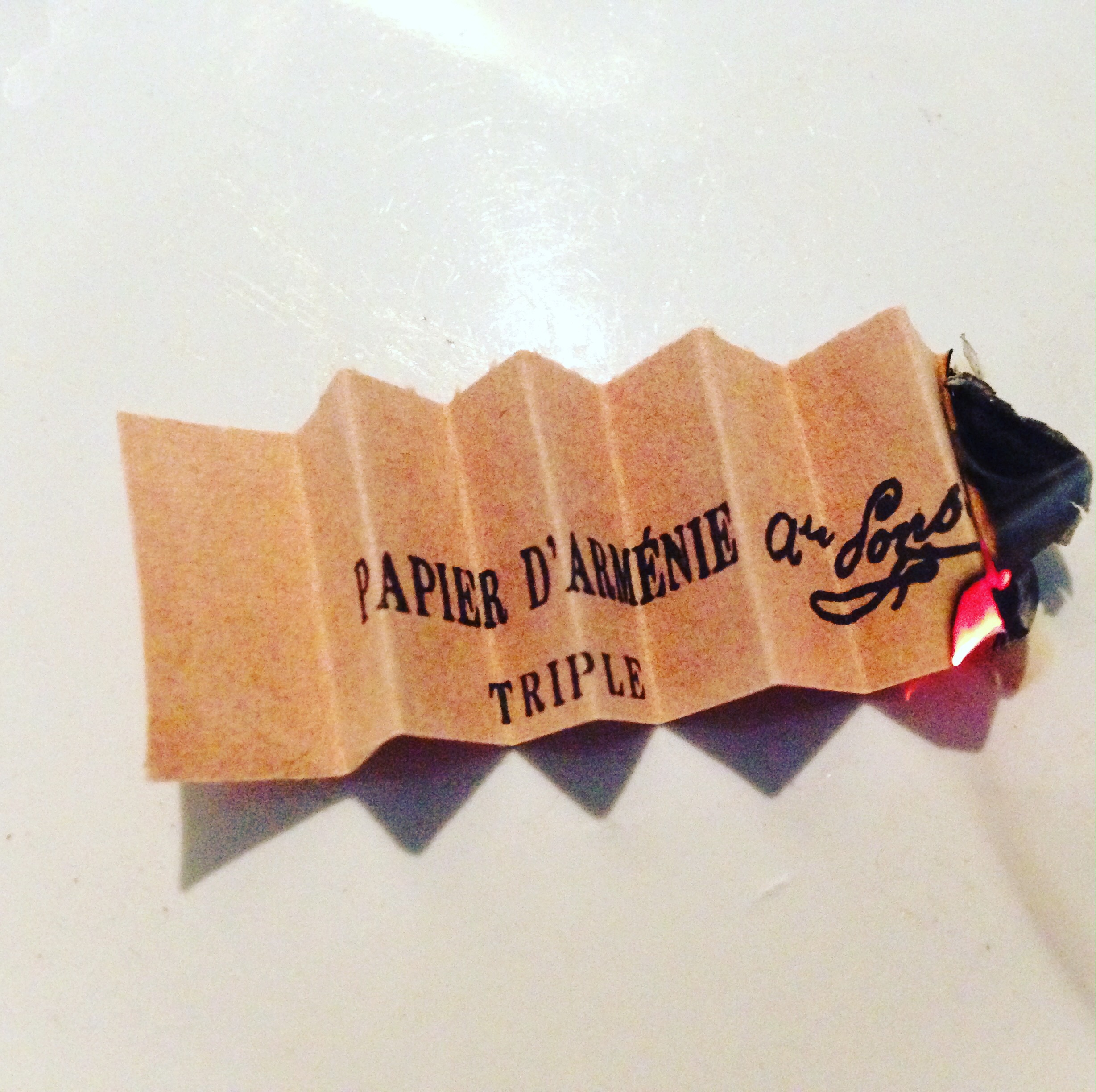
One of the world’s oldest ways to perfume one’s home; slowly burning Armenian papers, one of my favourite smells in the world, and reminds me of the smell of PlayDoh!
Smoke Amplifies Silence

ON THE SMALL HOURS

4am Thoughts

I was awake until 4am recently and the nights are short in summer so the dawn creeps in slowly, almost imperceptibly, until you notice a strange glowing silver light in your bedroom. Not the powerful, glorious, golden light of the fiery dawns of the East, but a soft, silver, early hour light, the half-light of poems and the North. It occurred to me that the East has no real twilight; sunset is dramatic and fast, the sun goes out with a flash and in the blink of an eye night has fallen, changing as quickly as the slides in my ViewMaster. But the North has a special light; the half-light, the twilight, between sunset and late evening, a soft curtain falling to whisper the end of the day and a gentle transition to usher in the night.

Pale and interesting!

Yeats is entirely appropriate here:

Had I the heavens’ embroidered cloths,
Enwrought with golden and silver light,
The blue and the dim and the dark cloths
Of night and light and the half light,
I would spread the cloths under your feet:
But I, being poor, have only my dreams;
I have spread my dreams under your feet;
Tread softly because you tread on my dreams.

There is no line in this poem that is not perfectly beautiful. When I read it I imagine the heavens as a revolving dome and the different casts of light falling as majestic, slow curtains. The setting is a theatre. Finally I imagine a poor, kind, yet noble man, despite his hardship, trying to do his very best for the woman he loves. I imagine not blue cloths but a gorgeous red carpet being unrolled for the lucky lady to step on. This could also be me.

Silver is beautiful. My year this year has been characterised by gold, and gold has been gaining in importance since I have been doing islimi, but silver is beautiful. Gold is the Renaissance era, both 15th-century Italian and 12th-century Islamic, or ancient Aryan India or Persia, martial Rome, Mayan, Aztec, early Christianity or brash modern China. Our wedding and the birth of our son were white and gold. Beginnings are golden. What era is silver? The Decadent era, the late 1800s, the turn of the century perhaps; silver implies endings. The silver screen maybe; silent films.

Caspar is gold.

At the last minute, Caspian is silver.

The sea can be silvery blue.

I love gold and have done so ever since I met my husband. Gold is masculine and silver is feminine and they complement each other.  Gold is ‘the best material’ – he taught me never to settle for less. He says, incidentally, that gold as a metal suits me better whereas in the past I always thought silver suited me more. Now I think that my olive skin actually suits both gold and silver; gold brings out the gold already in my skin and silver offsets the dark tone in it. My growing love of gold somehow parallels the rise of self-confidence in my life as I get older. But I am starting to notice silver coming back into my life. The colour of the night is silver in our bedroom. Silver of the fairy lights, of the mirrored reflections reminiscent of the jamkhane (mirrored room of the jamkhane, rooms of collection of the Shahs of the past, like cabinets of curiosities), of the iPhone screen as I type, of the tentative Northern dawn, of the general light cast in the room and of my sleeping husband’s hair. Silver, far from being secondary, is equally important to gold. All hail the night!

As a combination, one could have white gold ~

0004_the_fisherman_and_the_ifrit

NIGHT 3 – THE FISHERMAN AND THE ‘IFRIT

The original Arabian Nights book that started it all decades ago

ON 1001

1001, not 1000.

1001 implies that there is more yet to come, possibilities beyond possibilities, life unending.

A thousand nights – and another night, again.

It doesn’t end when it ends. It continues…

Perhaps round numbers are too even, too steady, too boring. The addition of a single night after the 1,000 already passed denotes more… and more… and more… breathlessly, wordlessly unfolding and expanding forever and in a single number encompassing all of the universe ~

0003_the_fisherman_and_the_ifrit